Citizens accept limits on public disclosure without equivalently abandoning authorized oversight. The secrecy dilemma is bounded, not generalized: the question is not whether accountability survives threat, but which accountability.
This page holds the material the single-screen poster could not: the full estimates, the mechanism evidence, manipulation checks, robustness, and heterogeneity. Everything here is Wave 1 (Taiwan, January 2026, N = 2,734). Wave 2 is in the field; no Wave 2 results appear on this page.
Abstract
When citizens face credible external security threats, do they simply trade away democratic accountability? This paper argues the answer is dimensional rather than categorical. Citizens distinguish between two separable objects of democratic information governance: public disclosure (what the general public and media can access) and authorized oversight (what legally empowered institutions can monitor). Under threat, these two dimensions need not move together.
Using a preregistered 2×2 survey experiment in Taiwan, I vary threat salience and the government's informational posture. The results reveal a clear asymmetry: both high threat and secrecy-expanding policy responses substantially increase acceptance of limiting public disclosure, but support for authorized oversight remains resistant to erosion. Under high threat, the negative effect of a secrecy-expanding policy on oversight support disappears entirely. This is consistent with a compensatory demand for authorized oversight as public disclosure becomes more restricted.
The pattern suggests that security pressure produces selective rather than generalized deference, with citizens showing greater tolerance for limits on public visibility than for erosion of authorized oversight.
The question
When governments invoke external threat to justify secrecy, do citizens give up democratic accountability?
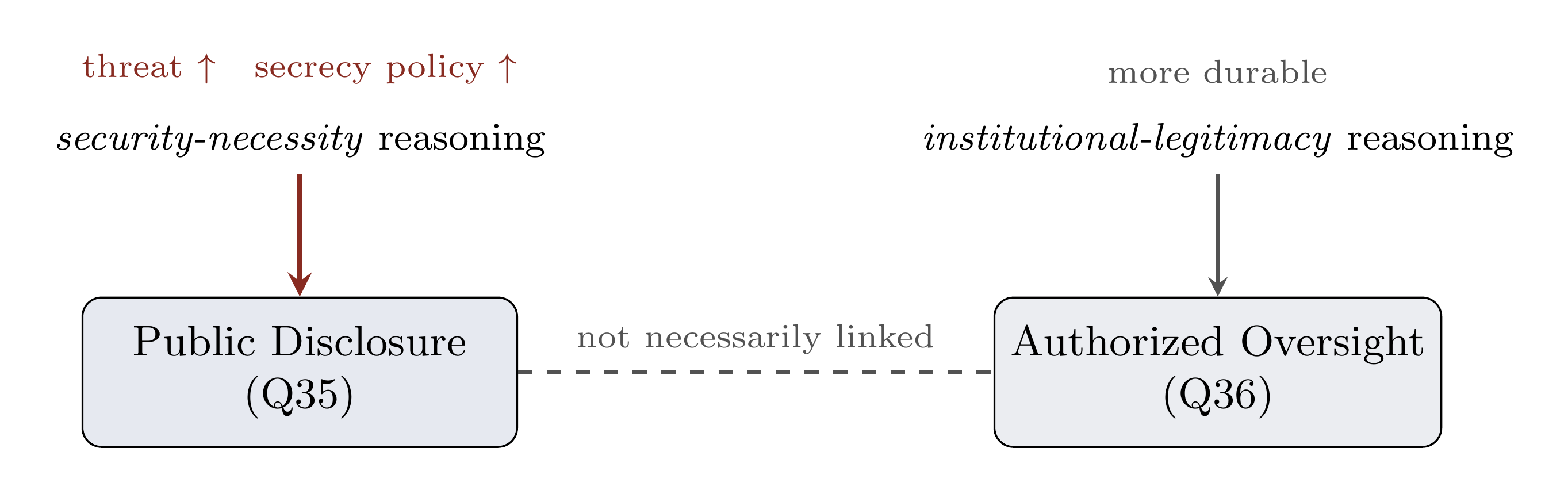
The risk is secrecy without authorized watchers. That risk only becomes visible once you stop treating "transparency" as one thing. Citizens separate two objects:
Hasym — Threat and secrecy policy move public-disclosure acceptance far more than they move oversight support.
Design
Preregistered 2×2 factorial, Taiwan, January 2026
| Oversight maintained | Secrecy expanded | |
|---|---|---|
| Low threat | Control | Overreach |
| High threat | Resilient | Emergency |
N = 2,734, SROD quota sample. Outcomes are 7-point scales: acceptance of limits on public disclosure (Secrecy) and support for authorized oversight (Oversight). Secondary outcomes measure perceived Efficacy and Abuse Risk.
Taiwan is a most-likely case for generalized deference. The cross-strait security environment is one of the most credible and sustained external threats facing any democracy. And the distinction between the two objects is not an artifact of survey design here: Article 31(3) of the National Defense Act provides that required defense reports may be prepared in classified and open versions, and the Legislative Yuan has fought over where that line falls — in 2012 and again in 2025. If citizens anywhere should collapse the two dimensions under threat, it should be here.
Manipulation checks — including the one that failed
- MC1 (threat). Both groups cluster mid-to-upper on perceived threat; the absolute shift is modest. Taiwan's baseline threat perception is already high.
- MC2 (public withholding). 55.1% vs 12.0% correctly identify the manipulation — strong.
- MC3 (oversight access). 34.3% vs 32.0% report that oversight bodies receive "full documents" — weak. Respondents largely did not register the oversight-access manipulation, which most likely attenuates the Oversight estimates toward zero.
- MC2-passer sensitivity (N = 1,467). Main estimates replicate.
MC3 is the honest weak point of Wave 1, and it cuts against the null result rather than manufacturing it: a manipulation people did not perceive cannot explain why oversight support held up. Wave 2 addresses the measurement side directly.
Main result
Preregistered OLS estimates
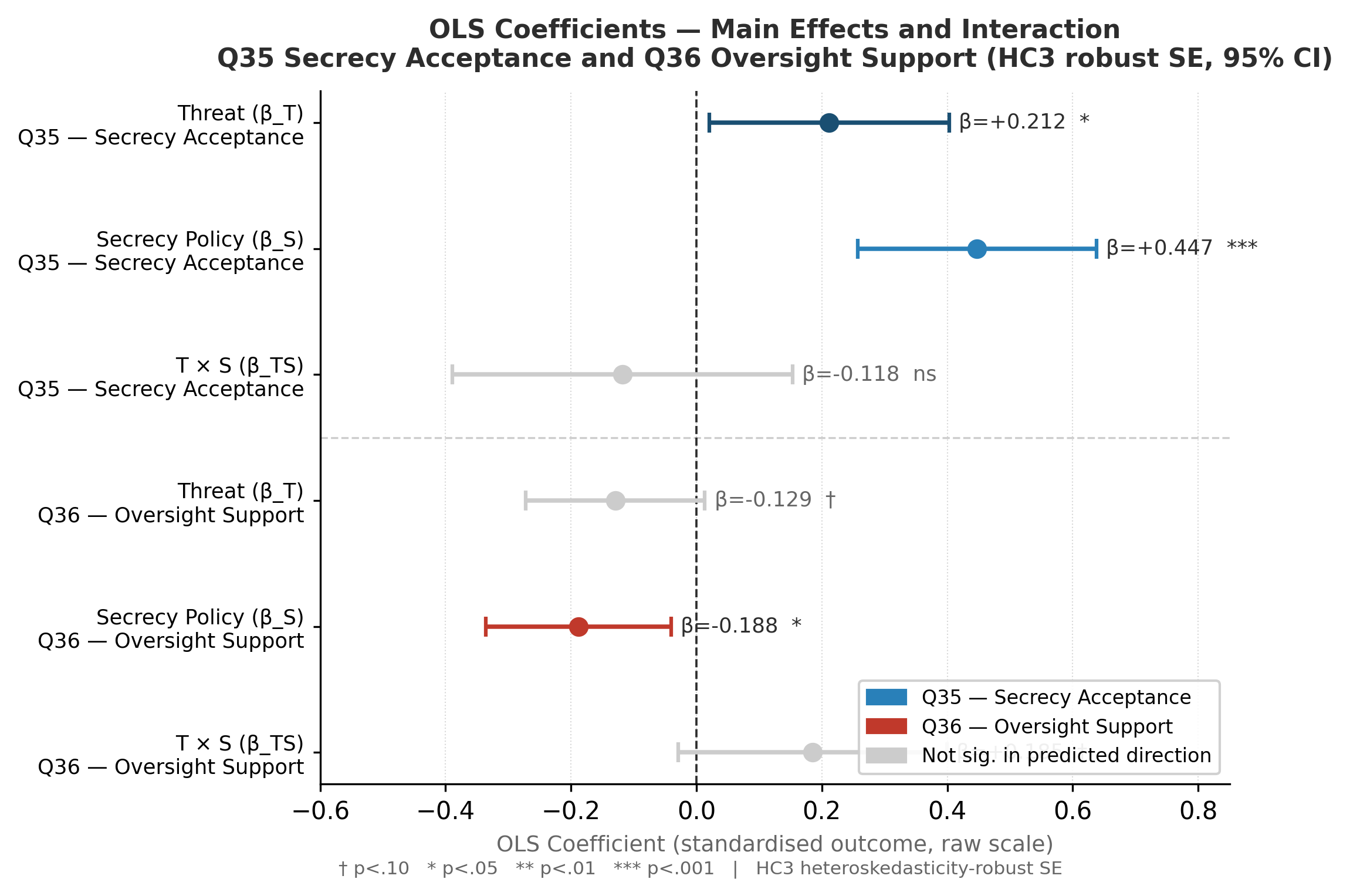
Threat and a secrecy-expanding response both push acceptance of limits on public disclosure up. Effects on authorized oversight are smaller, and what negative effect exists is conditional on threat.
The asymmetry
| Secrecy | Oversight | |
|---|---|---|
| High threat | +0.212 * | −0.129 † |
| Secrecy expanded | +0.447 *** | −0.188 * |
| Threat × Secrecy | −0.118 | +0.185 † |
| Baseline (control) | 3.801 *** | 5.512 *** |
† p<.10 · * p<.05 · *** p<.001 · HC3 robust standard errors · N = 2,734
Secrecy effects are 1.6–2.4× larger than oversight effects. The oversight cost of secrecy expansion (−0.188*) vanishes under high threat (−0.003, n.s.).
The baselines matter for reading this. On a 7-point scale, oversight support starts at 5.51 while secrecy acceptance starts at 3.80. Oversight is measured near its ceiling, which is exactly why the robustness checks below focus on whether that ceiling is hiding movement.
Cell means — where the spread actually is
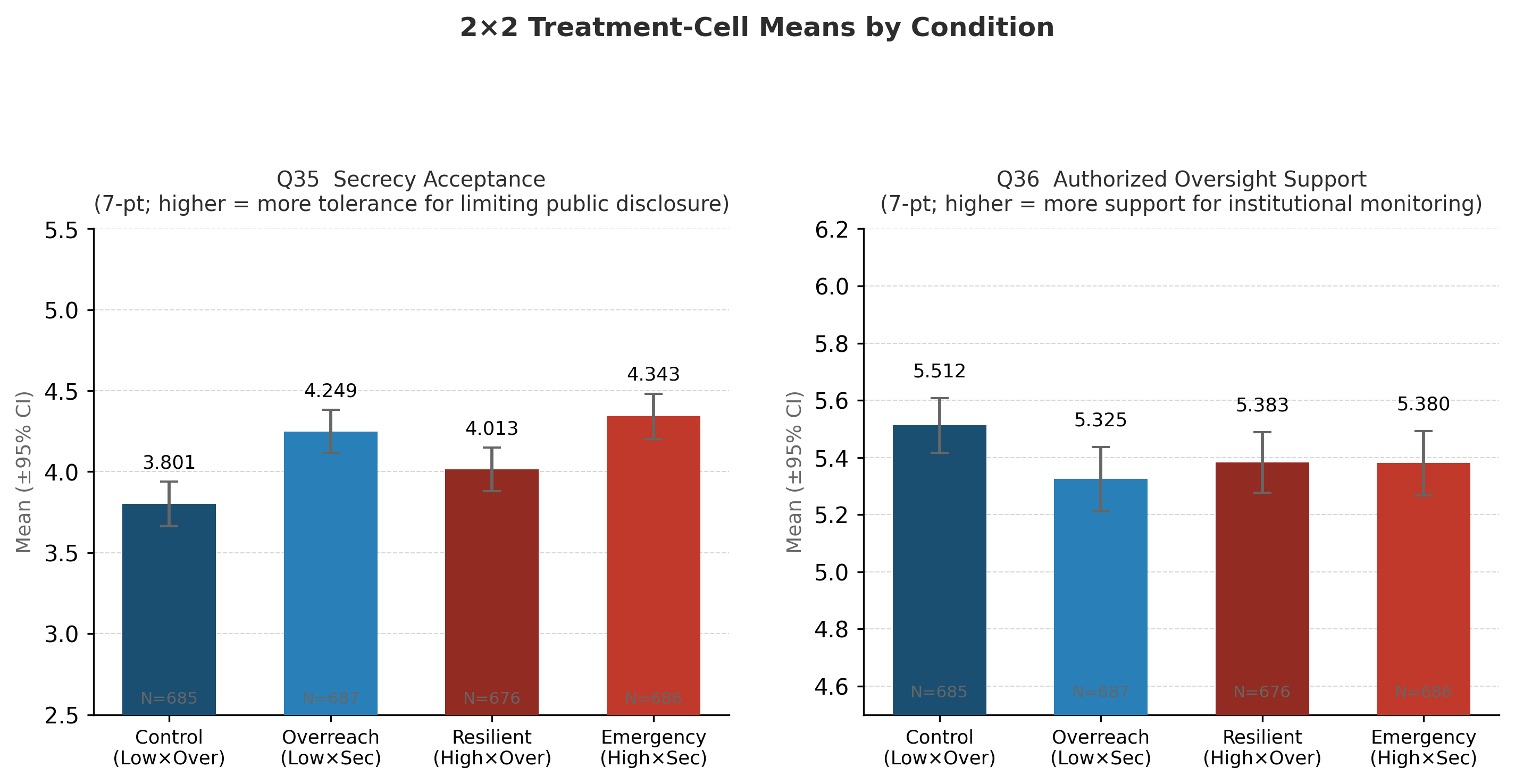
Public-disclosure acceptance spreads 0.54 points across the four cells. Authorized oversight spreads only 0.19, with cell means confined to [5.32, 5.51].
Robustness — four ways of asking whether this is real
- Covariate-adjusted OLS. βS on Secrecy stable at +0.39***.
- Survey weights. βS on Secrecy stable at +0.45***.
- Lower-tail binary logit (built for the Oversight ceiling). AME = +0.063***. Movement is not being swallowed by the top of the scale.
- Randomization inference. Secrecy F = 4.99, p < .001; Oversight F = 2.38, p = .063.
Mechanism
Why doesn't oversight fall?
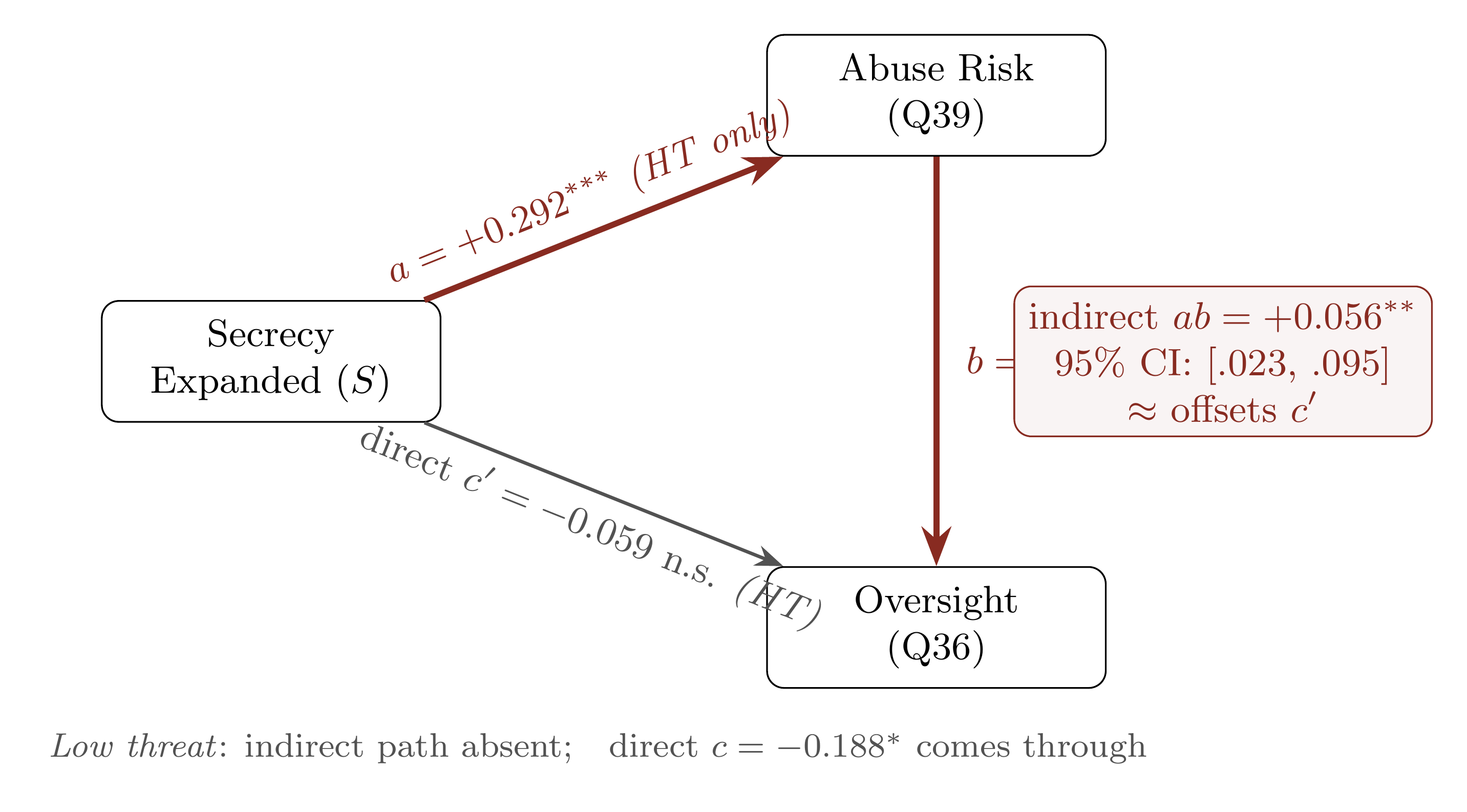
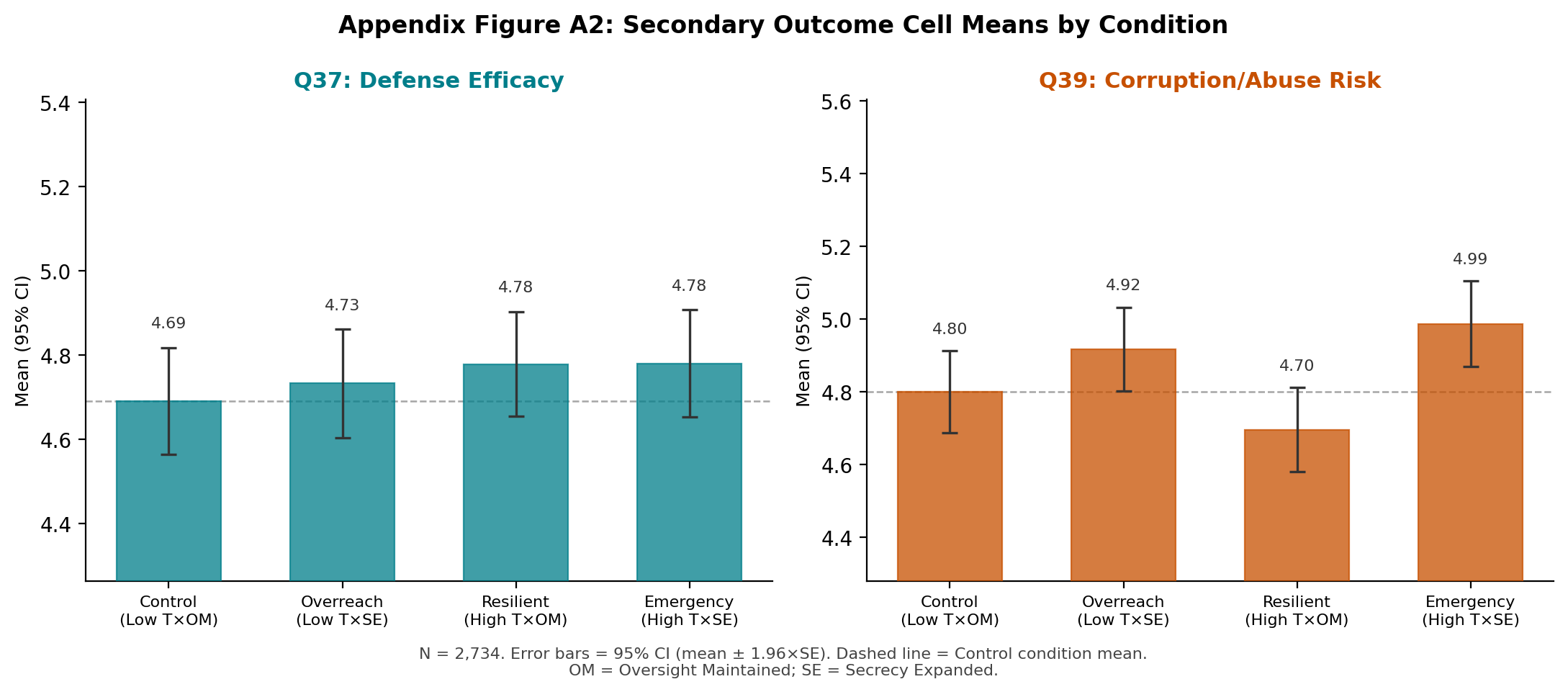
Under high threat, secrecy expansion raises perceived abuse risk (a = +0.292***), and abuse risk in turn boosts oversight demand. The indirect path (ab = +0.056**, 95% CI [.023, .095]) offsets the direct negative path, leaving a total effect near zero. Efficacy shows no treatment effects at all.
Read this as correlational. It is a Baron–Kenny path decomposition with a post-treatment mediator, not causal mediation. Establishing the indirect path causally would require a two-wave design measuring abuse risk before the outcome.
Secondary outcomes — Efficacy and Abuse Risk
Partisan heterogeneity — and why partisanship is not the story
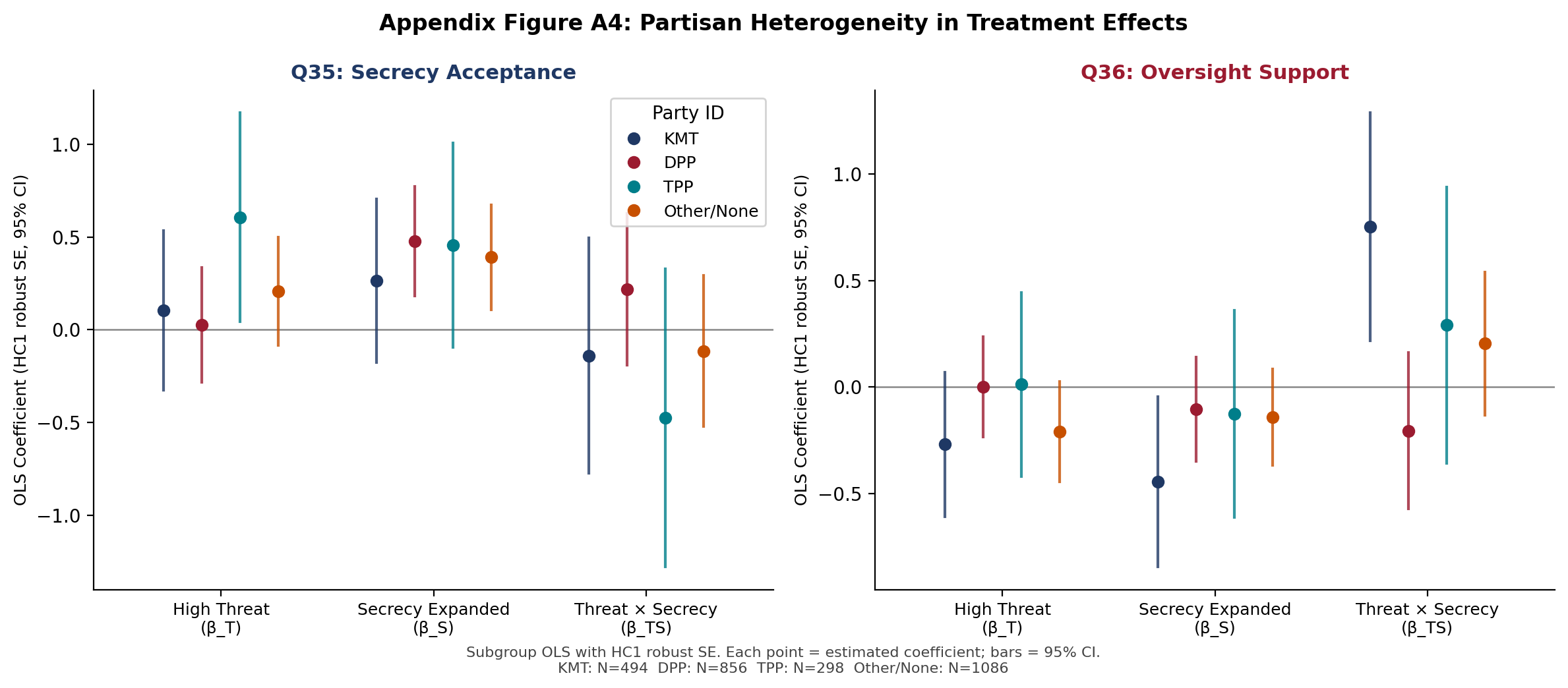
Secrecy acceptance moves broadly positively across camps. The compensatory oversight pattern is stronger among KMT than DPP respondents. The heterogeneity appears to run through institutional trust — legislative trust averages 3.19 on a 7-point scale — rather than through partisanship alone.
Exploratory: accountability orientation as a moderator
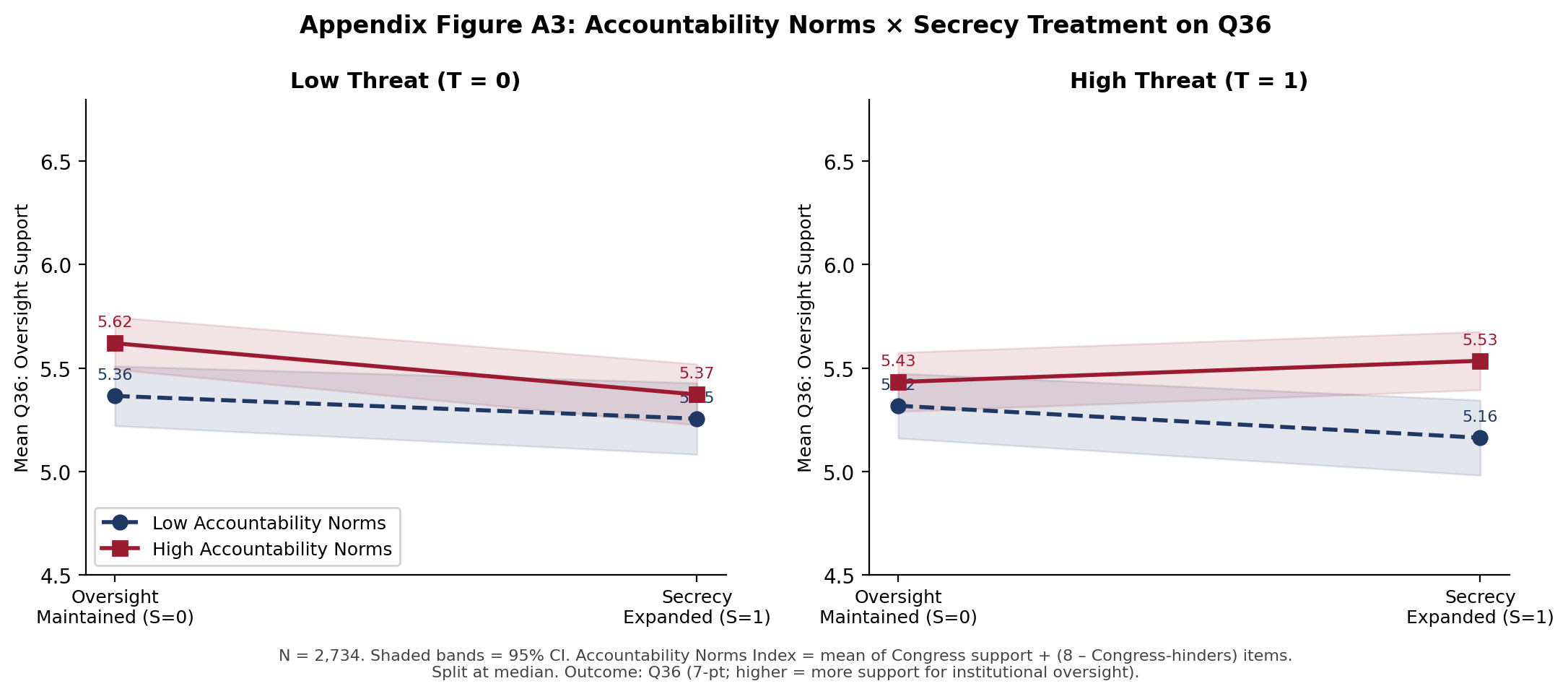
β(T×S×Accountability) = +0.424**. Exploratory and not preregistered — reported for completeness, not as a test.
Take-away
Citizens accept limits on public disclosure without equivalently abandoning authorized oversight.
The secrecy dilemma is bounded, not generalized. The useful question is not whether accountability survives threat, but which accountability — extending Colaresi (2014) from institutional design to mass preferences.
Limitations, and what Wave 2 does about them
- The oversight measure is ceiling-compressed. 57% of respondents score 6 or 7. Wave 2 adds a bipolar trade-off item with explicit costs at both ends, plus a minimum-oversight-requirement item, so movement has somewhere to go.
- The oversight-access manipulation was weak (MC3 above). Wave 2 keeps the vignettes verbatim, which makes it a direct replication, and puts the fix on the measurement side rather than the treatment side.
- The mediation evidence is correlational, as noted above.
- Wave 2 is in the field (N = 3,000, preregistered on OSF). No Wave 2 results are reported here or on the poster.
The paper
The current draft is an early-stage working paper and is not yet posted publicly. I am glad to share it — email me and I will send the current version.
The preregistration, materials, and power-simulation code are open at osf.io/utzme.
Citation
Yuru Fu · Department of Political Science, National Taiwan University
d14322004@ntu.edu.tw · ORCID · fuyuru.com